Boots
Men's vs women's cowboy boots
Shaft, calf, heel and last - four real differences, and the size conversion for buying across the aisle.
By Selena H. · Updated October 17, 2026
Spur & Stitch is reader-funded. As an Amazon Associate we earn from qualifying purchases - at no extra cost to you. Affiliate disclosure
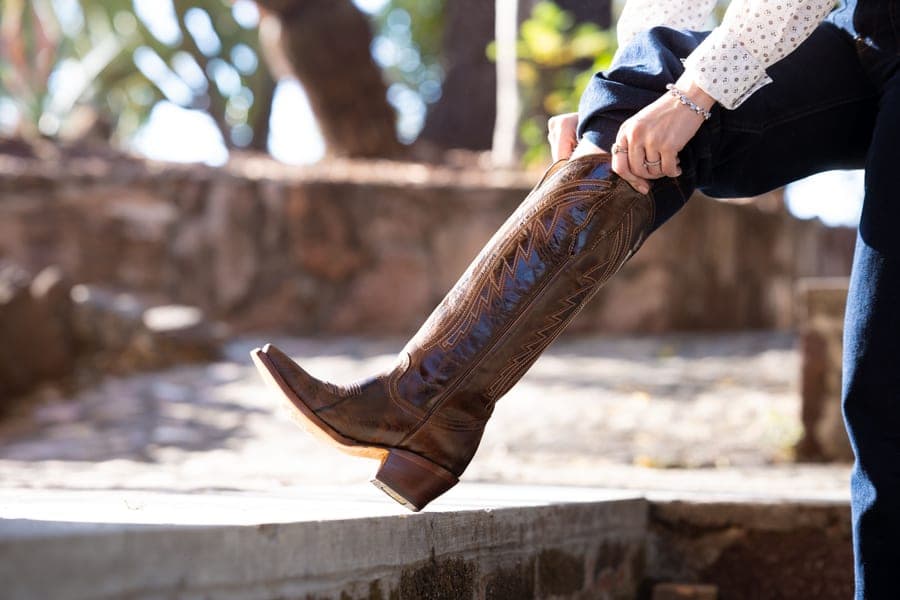
We choose picks by comparing published specifications, construction, sizing guidance and aggregated owner feedback. We have not worn these boots ourselves. How we pick
Men's and women's cowboy boots differ in four measurable ways: women's shafts are usually shorter (about 11 inches against 12 to 13), women's lasts are narrower through the heel and the ball, women's heels are often taller and more tapered, and women's boots are far more likely to be decorated. The sizing systems differ too - as a rough rule, a women's size is about 1.5 sizes higher than the men's size that fits the same foot. Always confirm against the maker's own chart before ordering.
None of this makes one category better. It makes them different shapes built for different average feet, and the useful question is which shape fits yours. Plenty of women with wider feet are happiest in a men's boot, and plenty of men with narrow feet find a women's last fits better than anything in the men's range.
The four real differences
| Feature | Men's boots | Women's boots |
|---|---|---|
| Shaft height | 12 to 13 in typical | About 11 in typical, with 13 in dress and decorated models |
| Last width | Wider through the ball and heel; D is the standard width | Narrower through the heel and the ball; B is the standard width |
| Heel | Roper to 1.75 in cowboy heel is the mainstream | 1.5 to 2 in, more often tapered or fashion-shaped |
| Calf circumference | Rarely a problem; shafts are cut generously | The most common fit failure - shafts are cut close |
| Decoration | Mostly plain, with stitched shafts | Embroidery, inlay, overlay and scalloped tops are mainstream |
| Toe shapes | Square, round, R toe, snip all widely available | Same shapes, generally in narrower widths |
Calf width is the difference nobody warns about
A women's boot that fits the foot perfectly can still be impossible to pull over a muscular or fuller calf, and almost no product page publishes a shaft circumference. This is the single biggest cause of women's boot returns. Several makers sell stretch-panel or wide-calf versions for exactly this reason. Measure the widest part of your calf before you order and treat that number as seriously as your shoe size - the method is in wide feet and wide calves.
Buying across the aisle
- Women buying men's boots. Common and sensible for wide feet. Subtract roughly 1.5 from your women's size - a women's 9 is approximately a men's 7.5. Expect a wider heel pocket, which can mean heel slip, and a taller shaft.
- Men buying women's boots. Less common but works for narrow feet, especially in the smaller men's sizes that some makers do not produce. Add roughly 1.5 to your men's size, and expect a shorter shaft and a narrower heel pocket.
- Always confirm against the maker's chart. The 1.5 rule is a starting point, not a standard. Some brands publish a 1 or 2 size offset instead.
- Check the width letter separately. A men's D and a women's D are not the same width - a women's D is a wide, a men's D is standard. Cowboy boot width letters sets out the whole system.
Pick 1
Ariat Heritage Roughstock - best for the safest first pair for most men
 Illustrative photo
If you want one boot that will not be a mistake, this is the one most first-time buyers end up in. Ariat publishes a full-grain leather upper, Goodyear welt construction, a 12-inch shaft and a 2-inch western heel, with its Duratread outsole and a removable Pro Performance insole. The reason it suits a beginner is the combination: the welt means it can be resoled instead of thrown away, and the cushioned removable insole means it is wearable on day one rather than after a month of pain. It is sold in a square toe and in narrower shapes, so you can pick the toe that fits your foot rather than taking whatever the model comes in. At the usual street price it sits in the middle of the market - above the mall-brand boots that are glued together, below the handmade tier you do not need yet.
What you give up: You give up character. This is the Toyota Camry of cowboy boots - nobody in a boot shop will be impressed, and the leather will not develop the patina a $400 calfskin boot does.
Good
- Resoleable welt at a mid-market price
- Removable cushioned insole - comfortable from day one
- Sold in several toe shapes and widths
Less good
- Visually unremarkable
- Rubber outsole is not traditional
| Toe | Square (narrower shapes also sold) |
|---|---|
| Shaft | 12 in (per Ariat) |
| Heel | 2 in western |
| Upper | Full-grain leather |
| Construction | Goodyear welt - resoleable |
| Outsole | Duratread (Ariat's rubber compound) |
Pick 2
Ariat Women's Heritage Western Boot - best for the safest first pair for most women
Illustrative photoAriat's women's Heritage line is the direct equivalent of the men's Roughstock and the same logic applies: full-grain leather, a cushioned removable insole, and shapes that come in more than one toe so you can match the boot to your foot instead of the other way round. For a first pair, the R-toe and round-toe versions are the ones to look at - they are the shapes that work with jeans, with a dress, and at a wedding, and they do not date the way a very pointed snip toe can. Ariat's sizing runs close to a women's shoe size for most people, which is unusual in western boots and genuinely helpful when you are buying online for the first time.
What you give up: You give up decoration. These are plain boots - no scalloped top, no inlay, no stitch pattern anyone will compliment.
Good
- Forgiving sizing
- Several toe shapes
- Wears with jeans or a dress
Less good
- Plain
- Mid-market price
| Toe | R toe / round, by model |
|---|---|
| Upper | Full-grain leather |
| Insole | Removable cushioned footbed |
| Heel | Low to mid western |
| Sizing | Close to street shoe size for most wearers |
Pick 3
Ariat Fatbaby Heritage - best for a short shaft and no break-in at all
Illustrative photoThe Fatbaby is the boot women who hate boots end up loving, and it is the most forgiving first pair on this list. Ariat lists 4LR technology for lightweight support and stability, an Everlon sole for cushioning, an 8-inch shaft, a 1.75-inch heel and the signature wide round Fatbaby toe. Everything about those numbers is beginner-friendly: an 8-inch shaft slides on without a fight and never touches your calf, the wide round toe means no pinching, and the cushioned sole means you can wear them out of the box. It is also the pair to buy if you have wide feet and have had bad luck with every other western boot.
What you give up: You give up the classic look entirely. The short shaft and wide toe read as a casual bootie, not a cowboy boot, and they will not work under a bootcut jean the way a tall shaft does.
Good
- No break-in
- Easiest shaft to get on
- Good for wide feet
Less good
- Not a traditional silhouette
- Short shaft limits jean pairings
| Toe | Wide round (Fatbaby) |
|---|---|
| Shaft | 8 in (per Ariat) |
| Heel | 1.75 in |
| Sole | Everlon cushioned |
| Support | 4LR technology |
#ad - price checked on Amazon at the time you click. Last price check: October 13, 2026. How we are funded
Are cowgirl boots and cowboy boots different things?
Not as categories, no. Cowgirl boot is a retail term for a women's western boot, usually one with more decoration and a shorter shaft. The construction, the shank, the welt and the purpose are the same. Nobody in the industry draws a technical line between them, and you should not pay more for one because of the word. The genuinely different categories are ropers, work boots and riding boots, which are covered in cowboy boots vs ropers and cowboy boots vs work boots.
Helps either way
The two things that fix most fit complaints, whichever side of the aisle the boot came from.
These links go to Amazon and we earn a commission if you buy. How we pick.

 Illustrative photo
Western Boot Insoles with Arch Support
For a boot that fits but hurts your arch.
#ad - price checked on Amazon at the time you click. Last price check: October 13, 2026. How we are funded
Price and quality by category
At the same price point from the same maker, the construction is usually identical - the same leather, the same welt, the same shank. Where women's boots cost more is in decoration: embroidery, inlay and overlay work is labor, and labor is the expensive part of a boot. A plain women's boot and a plain men's boot from the same line generally land in the same band. How much cowboy boots should cost covers the tiers.
Common questions
What is the difference between men's and women's cowboy boots?
Four things: women's shafts run shorter, around 11 inches against 12 to 13; women's lasts are narrower through the heel and the ball; women's heels tend to be taller and more tapered; and women's boots are far more likely to be decorated. The sizing systems also differ by roughly 1.5 sizes.
Can women wear men's cowboy boots?
Yes, and it is a good solution for wide feet. Subtract about 1.5 from your women's size as a starting point and confirm against the maker's chart. Expect a roomier heel pocket, which can cause heel slip, and a taller shaft.
How do I convert men's cowboy boot sizes to women's?
As a rough rule, a women's size is about 1.5 higher than the equivalent men's size - a men's 8 is roughly a women's 9.5. Brands publish their own conversion, so check theirs before ordering.
Are cowgirl boots the same as cowboy boots?
Yes, structurally. Cowgirl boot is a retail term for a women's western boot, typically with a shorter shaft and more decoration. The construction and the purpose are the same.
Why do women's cowboy boots have shorter shafts?
Mostly proportion - an 11-inch shaft sits at a flattering point on an average women's calf, and a shorter shaft is easier to pull over a calf that is cut close. Dress and decorated models go back up to 13 inches, where the shaft is part of the look.
Sources
About the author
Selena H.
Selena H. is the owner and editor of Spur & Stitch. She started the site after discovering how much western-boot buying advice assumes you already know what a welt is. Every guide here is written for the person buying their first pair.
Read next
Boots
The best cowboy boots for men
Seven men's western boots sorted by use - work, dressing up, standing all day, wide feet.
Boots
The best cowboy boots for women
Six women's western boots by situation - concerts, weddings, all-day wear, wide calves.
Fit & sizing
Cowboy boots for wide feet and wide calves
Two different problems with two different answers - plus the cobbler fix nobody mentions.
Fit & sizing
Cowboy boot width letters, explained
What B, D and EE actually change - and why toe shape usually matters more than width.
Fit & sizing
Cowboy boot size chart
Foot-length size charts for men, women and kids, plus what the width letters mean.